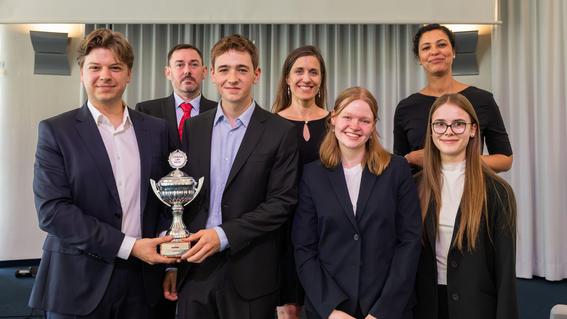
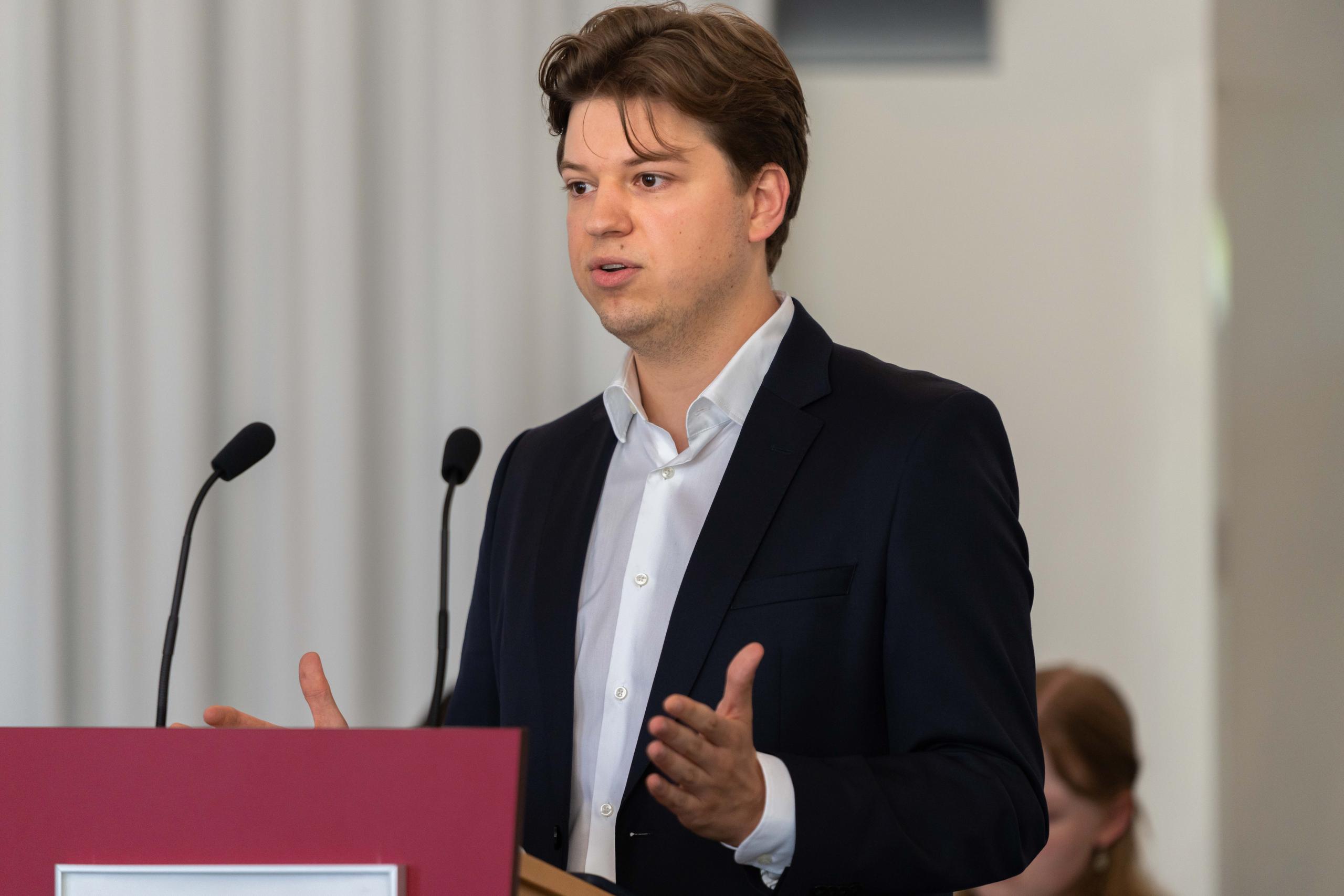
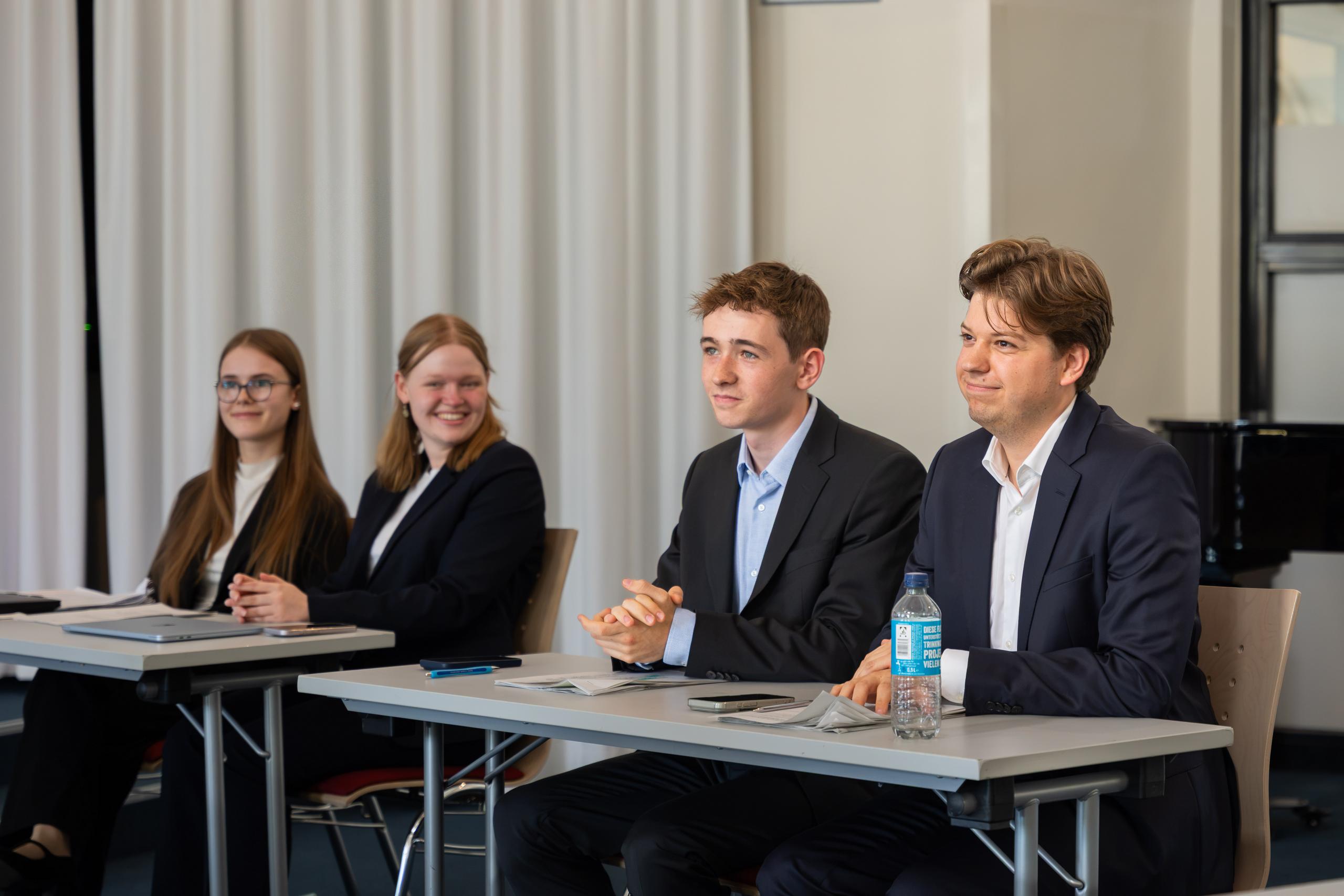
The Grand Final of the 19th annual Bucerius Common Law Moot competition took place on the evening of Tuesday, 23 June 2026. This year, the Grand Final was folded into a bigger event held to recognise and celebrate all the Bucerius Law School teams that took part in various mooting competitions over the previous year. As such, the Grand Final was well attended by students and was a resounding success.
This year’s problem involved the intersection between reality television and the law of contract. In particular, students had to grapple with the legal implications of a person agreeing to take part in a reality TV show and, pursuant to that decision, purportedly contractually limiting (1) her right to freedom of expression by means of a confidentiality/non-disclosure clause, and (2) her right to freely practise her trade or occupation by giving the show’s producers the right to take control of her social media accounts for six months. The problem therefore probed the ambit of the restraint of trade doctrine, as well as related concepts of unequal bargaining power and the proper approach to contractual interpretation.
This year, six teams made up of two students each took part in the preliminary round. The participants were Lukas Richter & Moritz Heinrich (Team 1), Anna Rath & Maybrit Knoke (Team 2), Torben Gehrke & Milan Kohlhaase (Team 3), Elianne Melber & Charlotte Hecht (Team 4), Timon Selen & Lisa Niesalla (Team 5),and Noel Bekeredijan & Julian Knötzele (Team 6).
Each team was required to moot once for the appellant (the TV producers) and once for the respondent (the reality TV contestant). Participants were also required to submit a set of skeleton arguments for the appellant and the respondent. As such, the competition developed students’ oral and written advocacy skills, as well as tested their ability to use precedent to construct compelling submissions for their clients. In this regard, students were given an array of case law from various common-law jurisdictions to peruse in preparation for the first round.
The quality of the mooting in the first round was excellent, and the judges were impressed by the nuanced and persuasive arguments on display at this early stage of the competition. Participants used the case law in a highly effective manner to make submissions regarding how the participation contract should properly be interpreted and whether the restraint of trade doctrine could be said to apply in this instance. Candidates also made strong policy arguments for the enforceability or otherwise of the contract.
Oral advocacy can be a nerve-racking experience at the best of times – even for those experienced at it – so the judges were especially impressed by the composed courtroom manner of all the first-round mooters. Without exception, all the participants consistently used the correct forms of address for the judges and their colleagues, and maintained an appropriately formal legal register for the duration of their appearances.
While all six teams acquitted themselves well in the preliminary round, unfortunately only Team 1, Team 2, Team 4 and Team 5 were able to proceed to the semi-finals. Accordingly, this year’s semi-finalists were Lukas Richter, Moritz Heinrich, Anna Rath, Maybrit Knoke, Elianne Melber, Charlotte Hecht, Lisa Niesalla, and Timon Selen.
The four teams that took part in the semi-final did so on a knockout basis, with the two winners of the round going through to the Grand Final. A toss determined which of these teams would act for the appellant and which for the respondent in the final round. As it happened, Anna Rath (senior counsel) and Maybrit Knoke (junior counsel) appeared for the appellants, while Lukas Richter (senior counsel) and Moritz Heinrich (junior counsel) acted for the respondents.
Judging the Grand Final were Lezel Roddeck (director of the Foreign Language Communication Programme at Bucerius Law School), James Linscott (Anglo-American law lecturer in the same department), and Professor Marah McLeod of the University of Notre Dame in the United States.
Anna Rath impressed the judges were her smooth delivery and ability to think on her feet in the face of fierce questioning from the bench on the issue of contractual certainty, while Maybrit Knoke stood her ground and with quiet determination robustly defended her client’s interests concerning the applicability of the restraint of trade doctrine in this instance. For his part, Lukas Richter made admirably compelling submissions on the non-applicability of the eiusdem generis rule with regard to the confidentiality clause, while Moritz Heinrich calmly and eloquently guided the judges through his submissions on the applicability of the restraint of trade doctrine in this instance, the reasonableness of the restraint in question, and whether the public interest precluded the enforcement of the restraint in this case.
The finalists were very evenly matched, so deciding on a winner was no easy task for the judges. However, having regard to both substantive and rhetorical factors, the judges decided the respondents Moritz Heinrich and Lukas Richter had the edge over the appellants and should be pronounced the winners of this year’s competition.
Lisa Niesella won the award for "Best Orator", while Torben Gehrke and Milan Kohlhaase (Team 3) won the award for "Best Skeleton Arguments".
The Foreign Language Communication Programme would like to thank all the students who took part in the competition, as well as the senior students with mooting experience who helped us judge the preliminary round. We would also like to extend our thanks to Professor Marah McLeod for so generously giving of her time to assist us with judging the Grand Final.
We are so pleased to see mooting go from strength to strength at Bucerius Law School with each passing year.