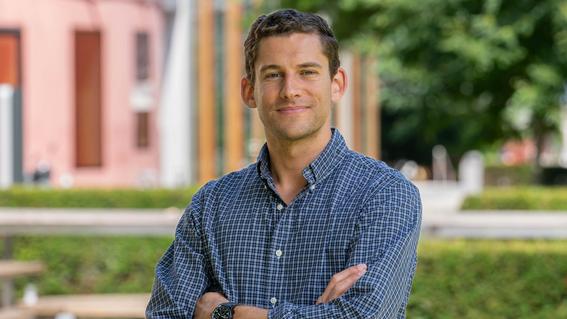
What is your academic and professional background?
As a Legal Engineer at Legora, an AI platform for law firms, I spend my days with lawyers: onboarding them, building their use cases with them, automating their workflows, and relaying their needs back to our engineers. Before that I practised at the Antwerp Bar for four years, first in employment law and then in corporate law after an LL.M. in International Business Law in Lisbon.
Why did you choose to participate in the AI, Legal Tech and Operations summer program?
I wanted to get sharper at pulling AI apart: what it does under the hood, where it breaks, and how to hold an argument about the future of legal services with people who see it differently. The other draw was the group: it's always enriching and motivating to spend time three weeks with thirty people from many jurisdictions and career stages.
How did the Berlin Study Trip contribute to the learning experience in the program?
The standout was our visit to YPOG. Sitting with the people running a modern law firm and hearing how they think about their structure, clients, and economics was worth the trip on its own. It was also my first time in the city, and the guided tour was a lovely addition, so thank you to the International Office for organising it. Such a trip does as much for a group as any structured session.
The summer program ends with a multi-day hackathon. What can you tell us about the challenge and the experience this year?
The challenge was to bring an innovation to dispute resolution. My team worked on a different delivery model for a law firm, offering AI-generated first assessments at fixed prices in order to lower the barrier to resolving a dispute.
Two days is short, and that is the point. We could not spend a day arguing about scope, so we committed to something and built out our agreed plan. What surprised me was how fast a rough prototype came together. Most of the work was not technical. We were pulling on what we had learned in class about building a firm: the mission, how you sell the service, the AI and regulatory constraints. Working with people you barely know and then pitching to a jury is its own lesson.
How was studying in such a diverse group beneficial to the learning experience?
A lot of it happened in the small group work. Session after session we had to reason through the regulator, private equity investors, what a future law firm looks like, alternative fee models, where dispute resolution is heading. Doing that with people who practise in completely different systems meant every assumption I walked in with got challenged by someone at the table.
The group also put me back in the position of listener. In my job I am usually the one talking. Here my view was one of many and I had to follow someone else's reasoning to the end before answering. That changed how I run conversations with the firms I work with, because I now know what it feels like from the other side of the table.
What new knowledge are you going to put into practice?
Thinking in my clients' terms. After three weeks inside the economics and governance of a law firm, I can hold a much better conversation about what a managing partner is actually weighing: what they are struggling with, which objections keep coming back, how the profession is being redefined around them. That context turns out to be harder to teach, and more useful, than anything about the technology itself.
What is the most interesting thing you learned academically and personally during the summer program?
Academically, the combination of the technical and the commercial. Going deeper on how the technology works, and alongside it on the economics of the profession: how firms price work, why moving off the billable hour is harder than it looks on a slide, how regulators, investors and partners pull in different directions on the same decision. Those constraints explain most of what does and does not happen in legal innovation.
Who would you recommend the program to?
To anyone who works around legal practice rather than only inside it: legal engineers, innovation and operations teams, people on the technology side, and lawyers who suspect their firm will look different in five years and want to understand why.
Especially to people earlier in that kind of career. If you are in client conversations every week you will already know some of the market context. If you are not, three weeks like this hands you a map of the industry. And if you talk to legal teams for a living, it is worth sitting in the classroom next to them for once rather than at the front of it.
How did you enjoy Hamburg? How did you spend your time away from campus?
Hamburg deserves its reputation as the prettiest city in Germany. It is green and built around water, so I ran around the Alster most days, kayaked on it, sat in the parks whenever the sun was out and cycled around the city. Very easy to slip into holiday mode.
Is there anything else you would like to share with future international students at Bucerius?
Come with questions rather than expectations. The people who got the most out of it arrived with something specific they were trying to work out and spent three weeks chasing it. And use the room. The cohort, the faculty and the practitioners passing through are the substance of the program, and all of them are more approachable than you would assume. Some of my best conversations were over coffee with people whose work looked nothing like mine.