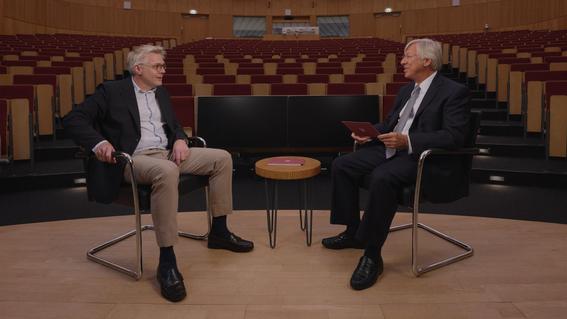
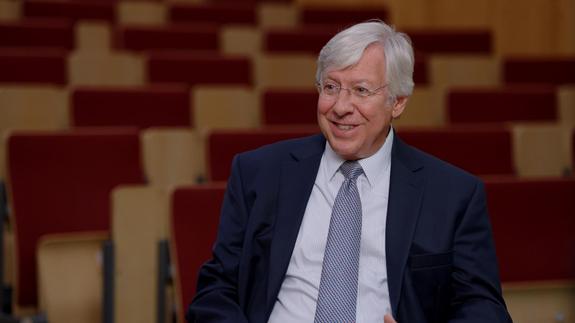
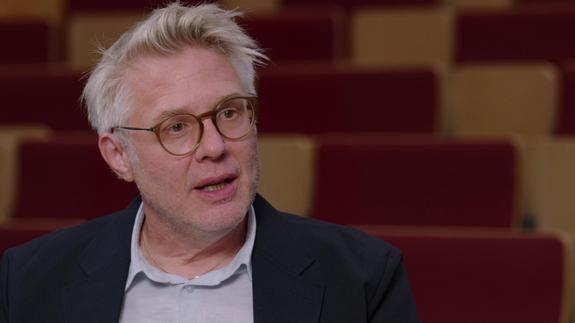
The MLB program is designed for individuals with a first university degree who wish to pursue further education in law and business. Professor Clifford Larsen founded the MLB program in 2006, Professor Christopher Bisping has been the Dean of the MLB program for five years. This interview is a short version of the video in which they talk about the program's beginnings and its development.
Christopher Bisping: Where did the original idea for the MLB program come from? And how did you get the program started?
Clifford Larsen: I was teaching my first international business transactions course. And part of the assignment for the students was to read the international pages of the Wall Street Journal every day. The pages were filled with all kinds of topics that were relevant to both business people and lawyers, accounting topics, mergers and acquisition topics, whatever the case may be. And half the group said: ‘We don't have time for that’ and immediately dropped the course. And I was thinking: you'd better find time for it, because that's what lawyers do. I realized at that moment, that something had to change. We sat together and came up with an entrepreneurial idea that would allow us to bring lawyers, business people, and others together in a new environment that did not exist. And here we are 20 years later.
Christopher: What was the atmosphere like in those very early days?
Clifford: We knew we were doing something different. And that excited people – to be on the vanguard of a new project. And I think that to a significant extent this has continued through the program. I think that's one of the reasons why the relationship among the alumni is so tight; it’s because they know they are doing something different.
Christopher: And of course it's in line with our Bucerius motto of courage, Mut. So the people have courage to come here. You had the courage to start the program. And the ZEIT foundation had the courage to support it.
Clifford: Why do you think the program has remained successful for 20 years and what makes it different from similar programs?
Christopher: We never stand still, we keep developing, adapting to new challenges. We’ve recently had a massive move towards artificial intelligence, which is a challenge to higher education in general. The other aspect is, of course, that we are still at the edge of development in bringing the two disciplines together in a market where people are needed that do not just know the law, or not just know management, but who can talk to their colleagues from the other branch and therefore are able to communicate and to push projects through, which others couldn't.
Clifford: And it's been a challenge and a pleasure to see how these two groups start to realize that they have to be able to work in both of these fields if they really want to arrive at the tops of their respective careers.
Christopher: And we've not yet mentioned the international aspect. How we thrive by being an international community and how we bring different cultures, different traditions together, and all learn from each other…
Clifford: We are a community of scholars here and that means you respect differences. You can disagree, but you do it respectfully. And we've had that in any number of contexts.
Christopher: What do students consistently say they value the most?
Clifford: I think they take some different approaches on what they value most. One of the main answers is learning to think as the other groups do, whether it be the lawyers and the business people and the ‘neither nor’, the people who come from other backgrounds entirely. One of the things that happens at graduation every year, is that the graduating class sits on one side of this auditorium and the incoming class sits on the other. And we emphasize that crossing these few meters is gonna take a year of a lot of hard work. And that is something that the students repeat year in and year out when they talk to their successors.
Christopher: What inspired you to introduce a social project?
Clifford: There is the moral obligation to give back to society. The people who come here sometimes come from very modest backgrounds in countries where very little money is earned, but everybody here is in a position to give back to society in some way. And we've had students going to one country to work in orphanages. We've had people put on a fashion show to raise money for children's cancer research.
Christopher: Studium Generale is one of the aspects, of course, which sets us apart from many other programs, or from any other program that I'm aware of, in that students represent their own countries, which goes towards raising awareness of where the other comes from, what their cultural background might be. […] Reaching a deal or entering a negotiation with somebody, there can be friction, but we are there to overcome it. And the law is a tool to achieving that. But in addition to the law, we need a lot of empathy, emotion and sensitivity for where the others come from.
Clifford: What are the challenges in postgraduate education? How will the MLB program react to these challenges?
Christopher: We have fully embraced artificial intelligence by teaching students to very cautiously and responsibly deal with it, use it where it is the right thing to use to save time in repetitive every day task without losing their own spark, their own creativity and their own input.
Christopher: Why do students choose the MLB program?
Clifford: It's an environment where people from all over the world come together. There's no one country's legal system or business system at the center. It's all in English, which is something that has to be emphasized as well.
Christopher: We've got a very unique point in that all the law we do is business law, but we don't limit it to business law. We have an equal amount of proper management business studies and our studies of law. Where else could you submit a business plan as a dissertation for your master thesis? And sometimes you've got somebody with a law background who, while they were here, suddenly thought, there's something new that I could try. So it allows people without incurring too much risk to explore an idea, to benefit from expert advice and then maybe to take it one step further.
Christopher: What is your wish to the MLB program for its next 20 years?
Clifford: My wish for the program is that it remains true to its original founding principles but continues to develop and improve on those principles. But I felt very comfortable that you were going to, while maintaining the fundamental principles, change the program in ways that actually improved it. And that was a very good feeling.
Christopher: Thank you very much. Well, I haven't killed it yet. That's a good thing, isn't it? So it's still there, alive and kicking.
Clifford: What would you wish for in the next 20 years for the MLB program?
Christopher: I hope that we'll still be going strong; that we'll still have the institutional support; that we will redefine our niche in an ever-changing market; being true to our founding principles of providing an interdisciplinary international and practice for course education.
Christopher: It was five years ago, Cliff, roughly, that we met for the first time when you handed that baton, the leadership of the MLB program to me, and now we are here today, 20 years of the MLB program. I'd say let's meet again on the 40th anniversary in 20 years time, what about that?
Clifford: Deal, I'll be there, I look forward to it.
Christopher: I look forward to seeing you then at the latest.